



The Complete Guide to Dynjandi Waterfall in Westfjords
- Waterfalls, Westfjords
- 21 Sep 2026
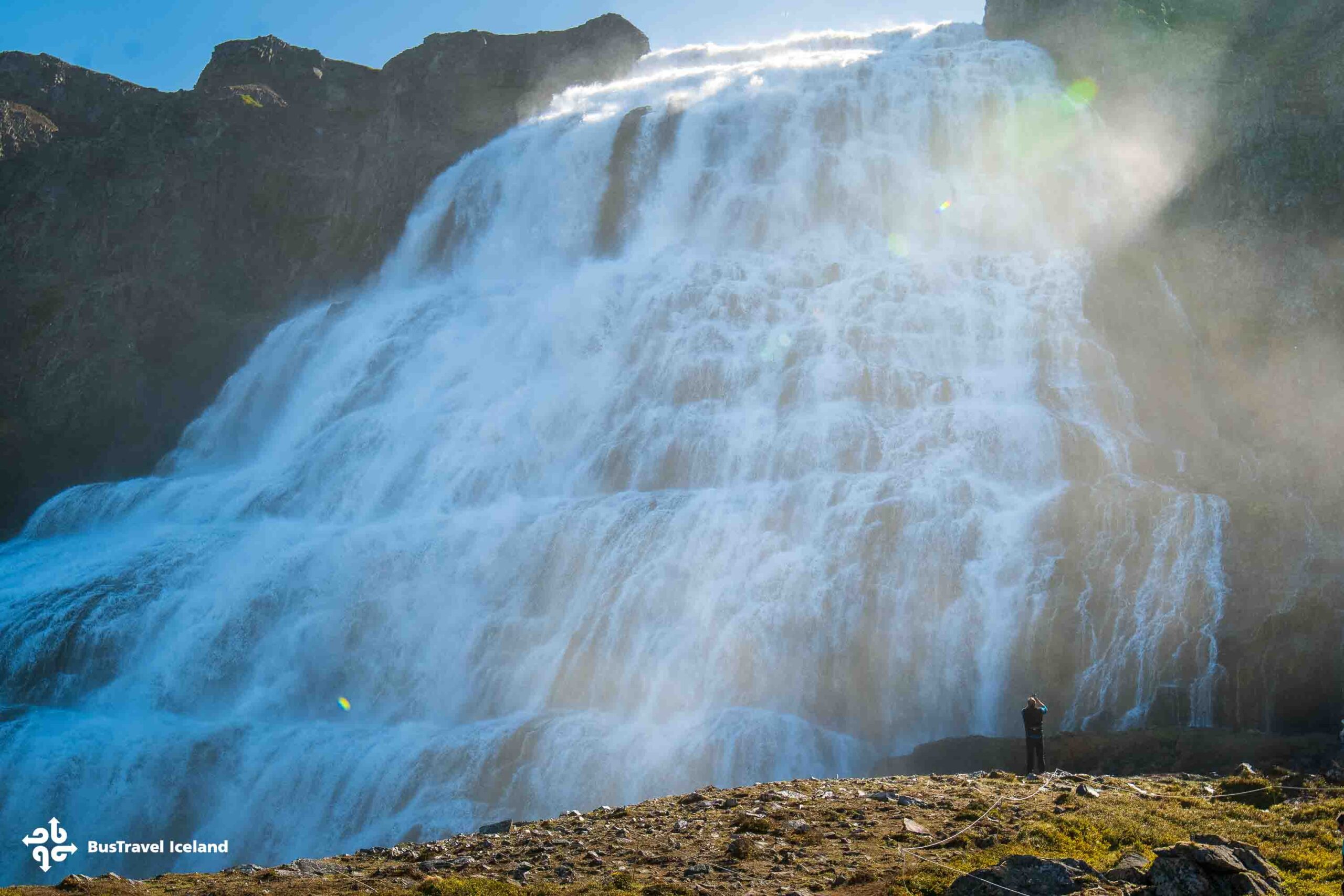
Dynjandi Waterfall is one of the great natural landmarks of Iceland’s Westfjords. Famous for its broad, fan-shaped cascade and the series of smaller waterfalls below it, Dynjandi is a place where the geology, history and wild landscapes of the Westfjords come together.
But where exactly is Dynjandi Waterfall, and how do you get there? How high is Dynjandi, and why does it have such an unusual shape? How long is the walk to the waterfall? When is the best time to visit? Can you visit Dynjandi from Ísafjörður, and can you see it as part of a cruise shore excursion?
In this guide, I’ll take you through everything you need to know about Dynjandi Waterfall, with practical information to help you plan your visit and build it into your Westfjords itinerary.
Dynjandi Waterfall: Quick Facts
Location: Arnarfjörður, Westfjords, Iceland
River: Dynjandisá
Height of main waterfall: Approximately 99–100 metres
Width: Approximately 30 metres at the top and 60 metres at the bottom
Protected since: 1981
Walk from parking area: Around 15 minutes to the main cascade
Recommended visit: At least 45–60 minutes for sightseeing, around 2 hours for photography
Facilities: Parking, toilets, accessible parking and picnic facilities
Accessibility: Paved lower path to Hrísvaðsfoss; natural, uneven trail beyond
Overnight stays: Not permitted
Best-known feature: Its broad, fan-shaped cascade over a staircase of ancient basalt
What is Dynjandi Waterfall
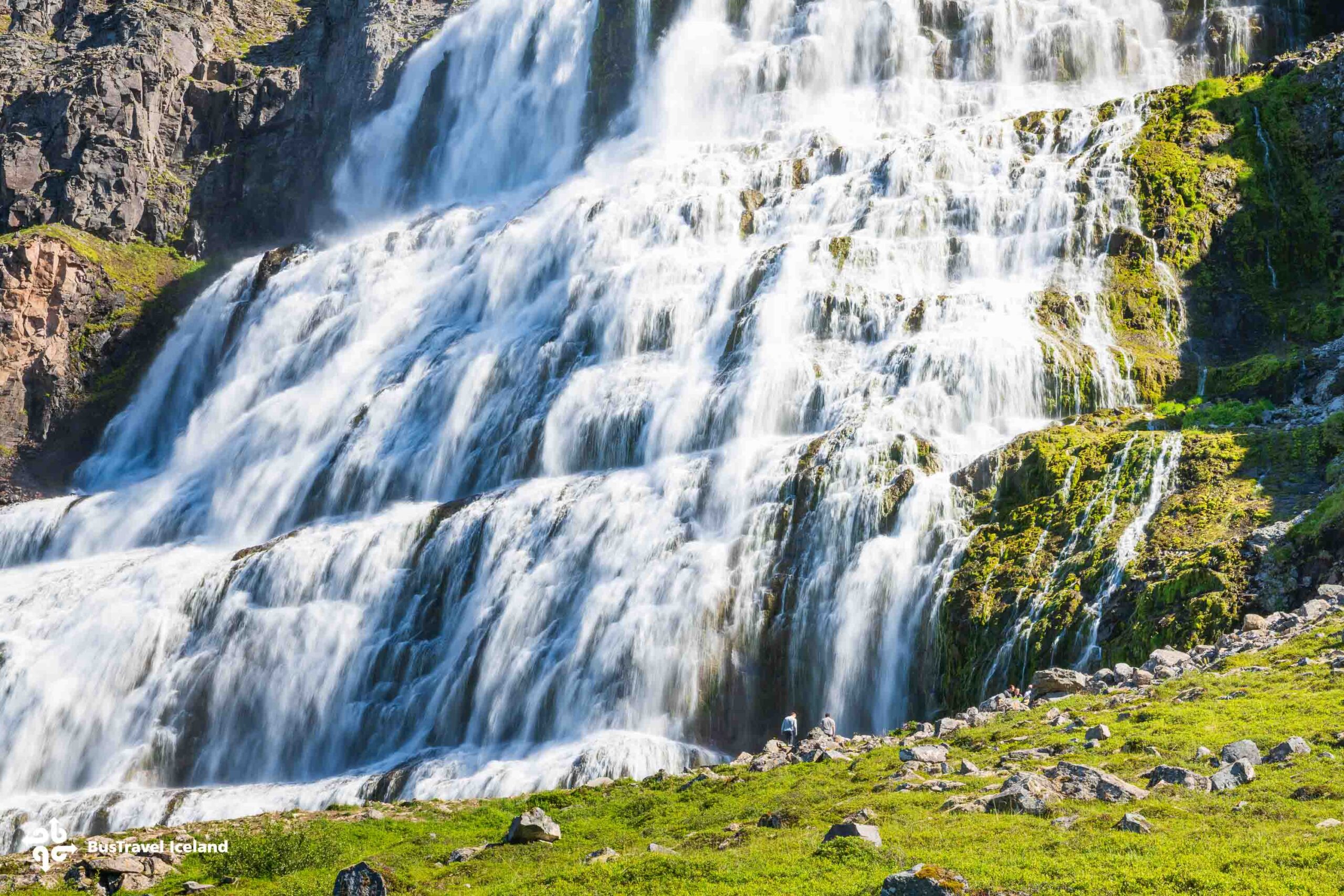
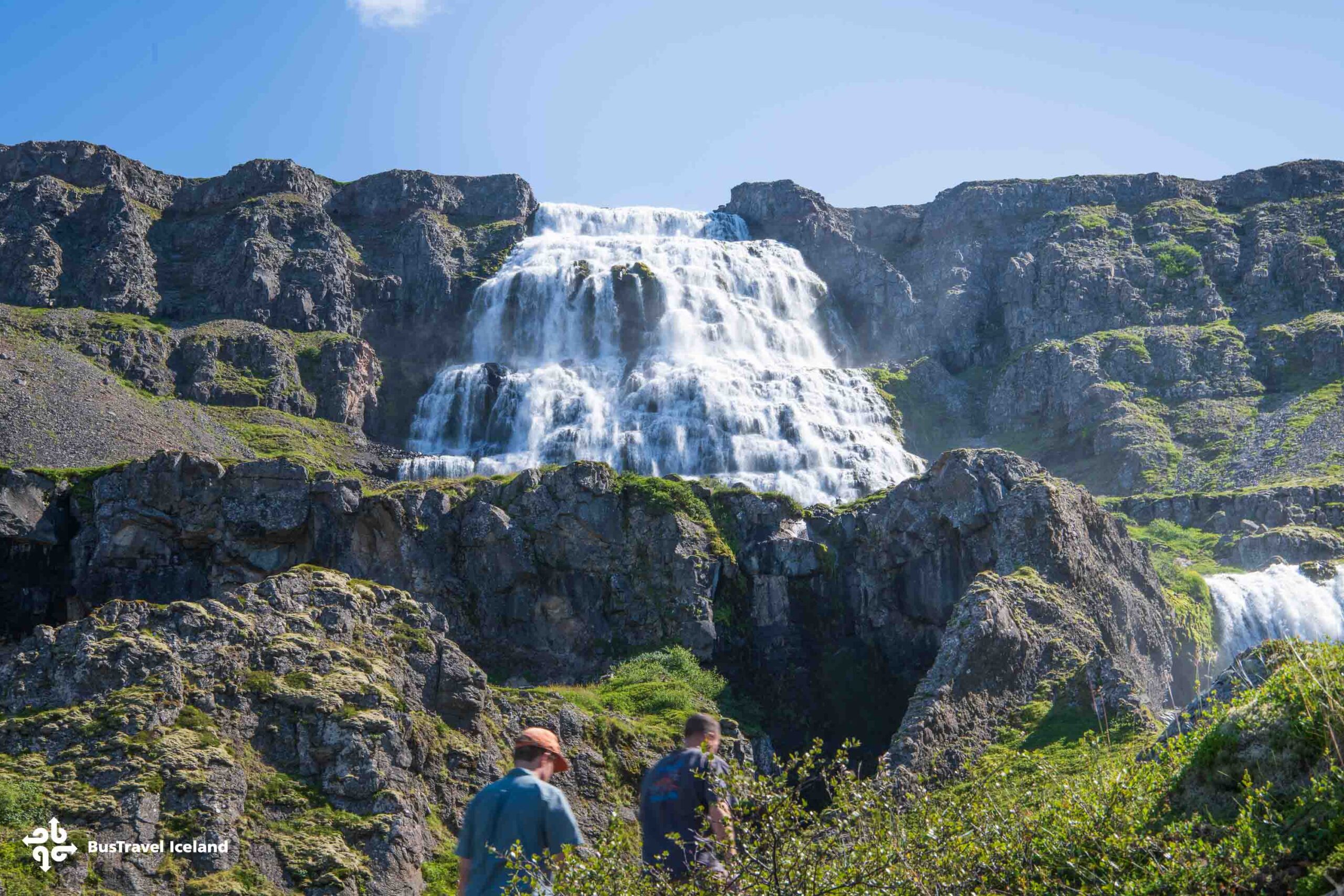
From across Arnarfjörður, Dynjandi does not immediately look like an ordinary waterfall. A white streak appears high on the mountainside, broadening as it descends through the dark horizontal layers of rock. Get closer, and the scale begins to change. The white streak becomes an enormous curtain of moving water, while a succession of smaller waterfalls appears below it, carrying the river almost all the way down to the sea.
This is Dynjandi, the largest and one of the best-known waterfalls in Iceland’s Westfjords.
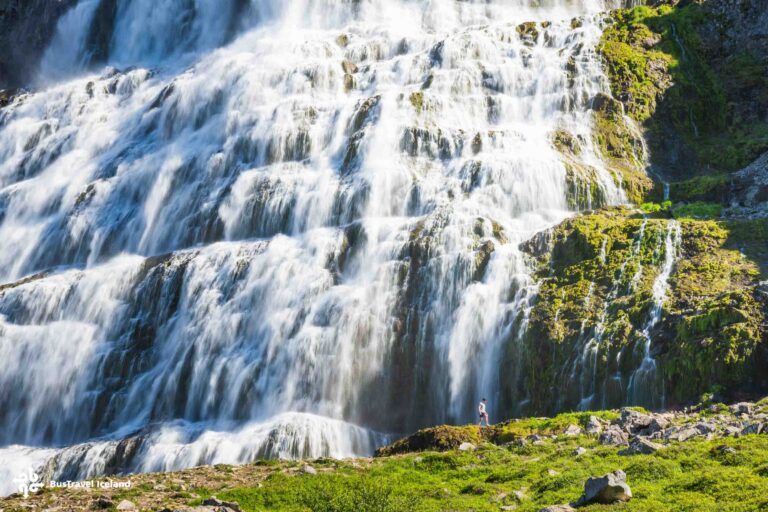
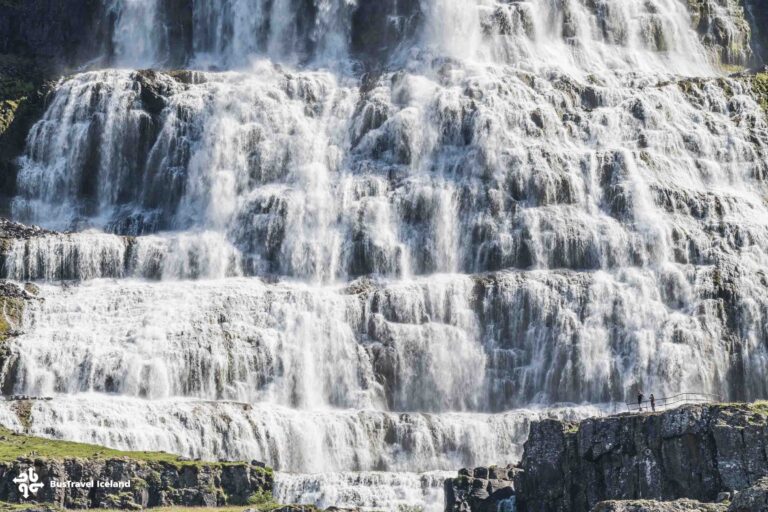
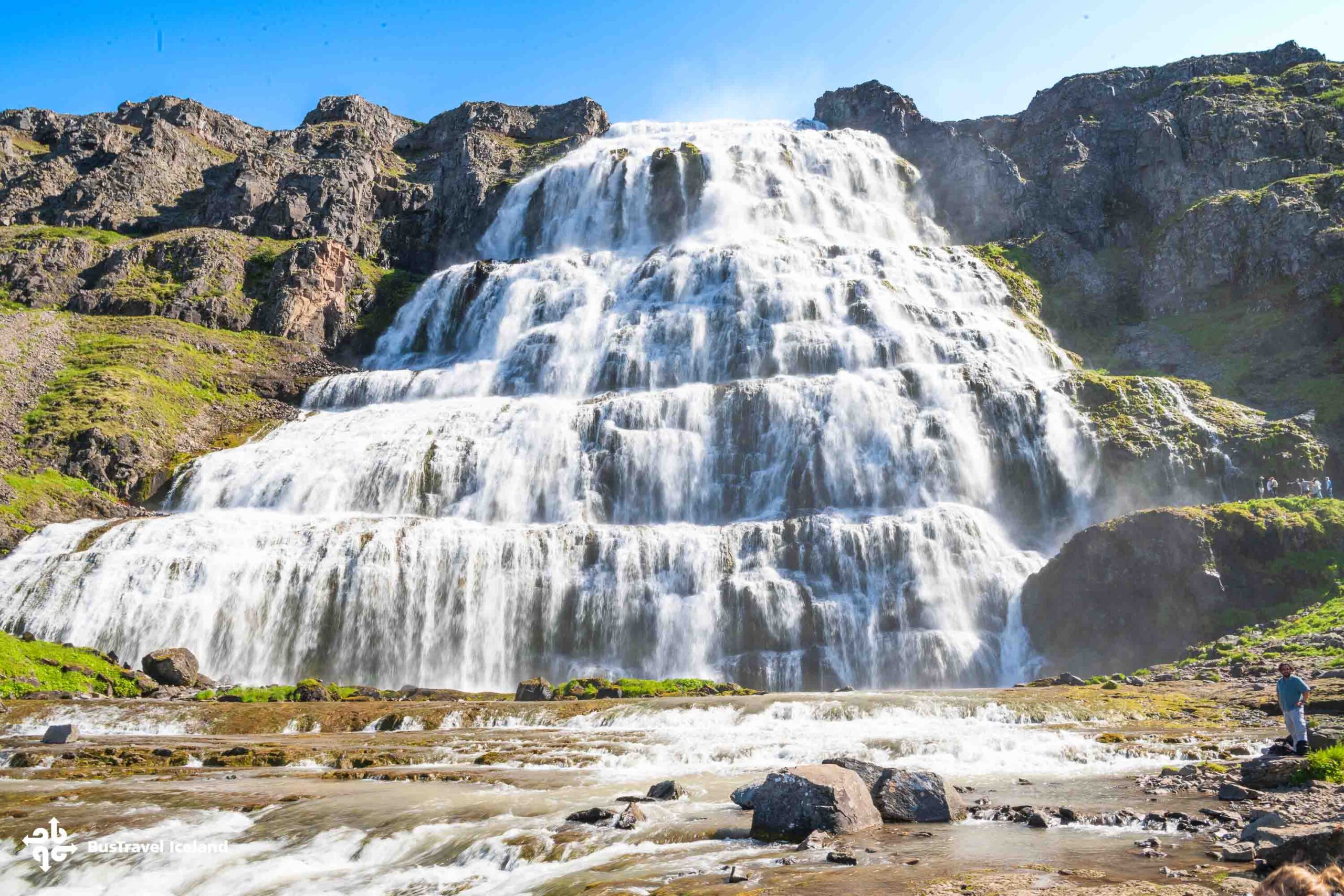
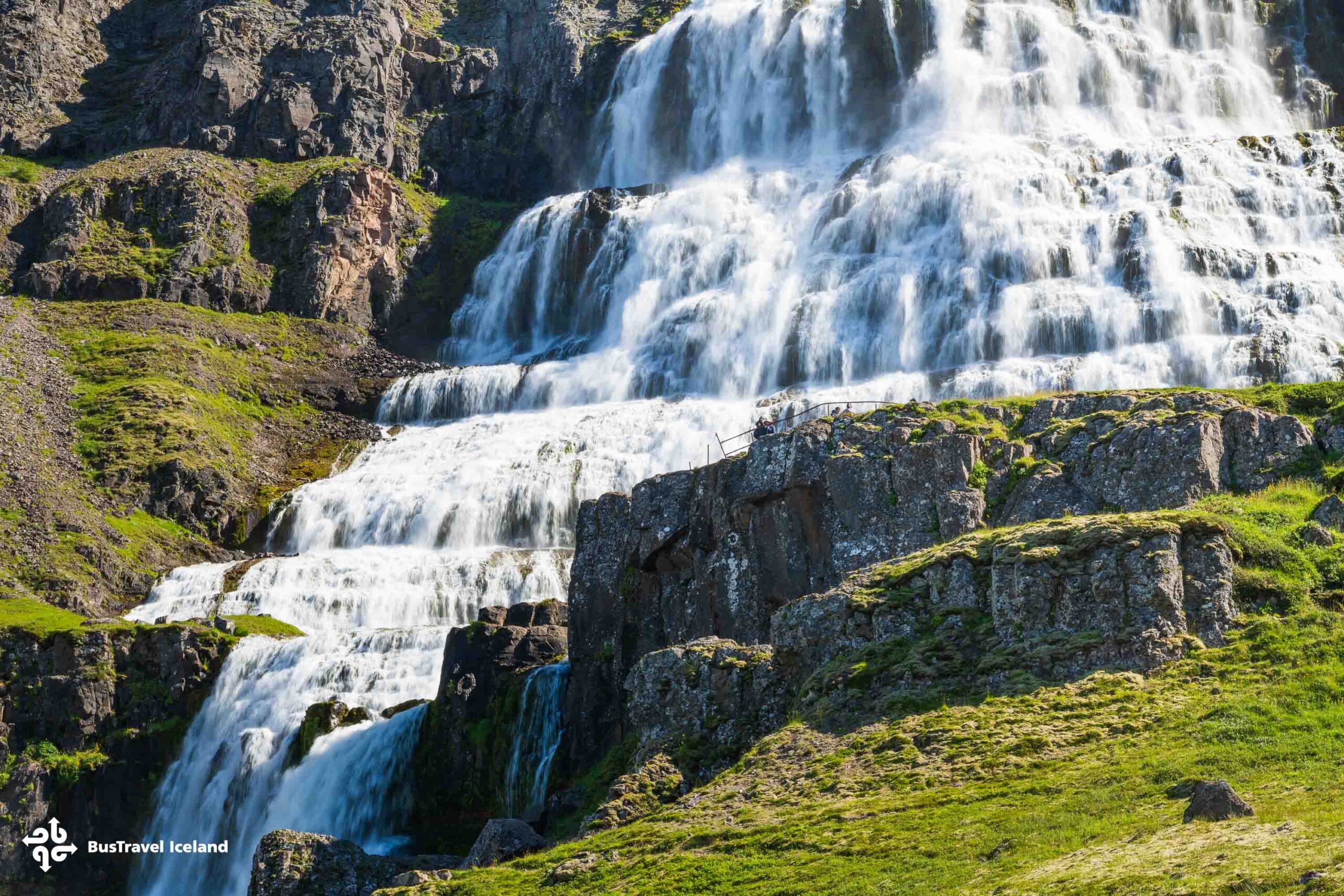
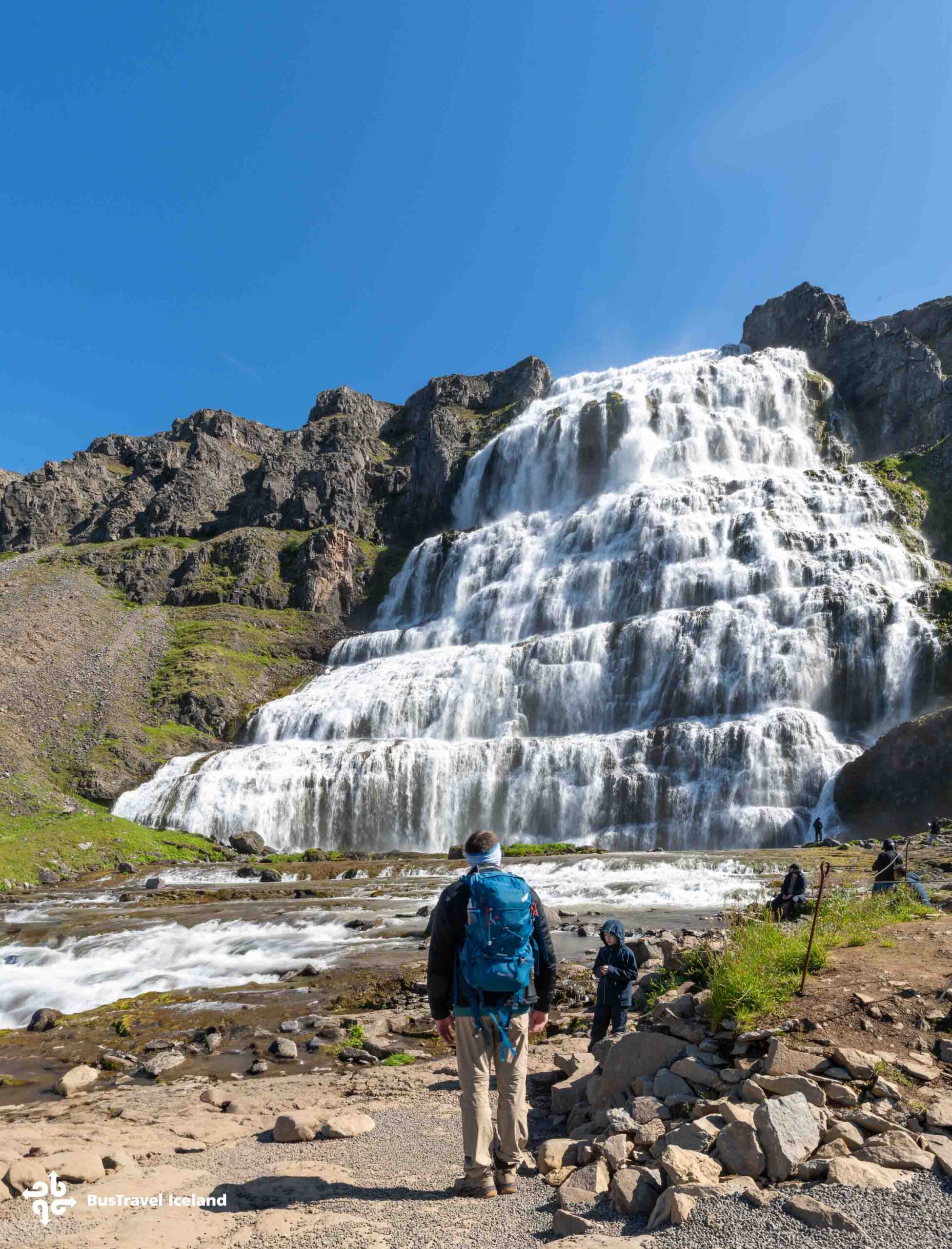
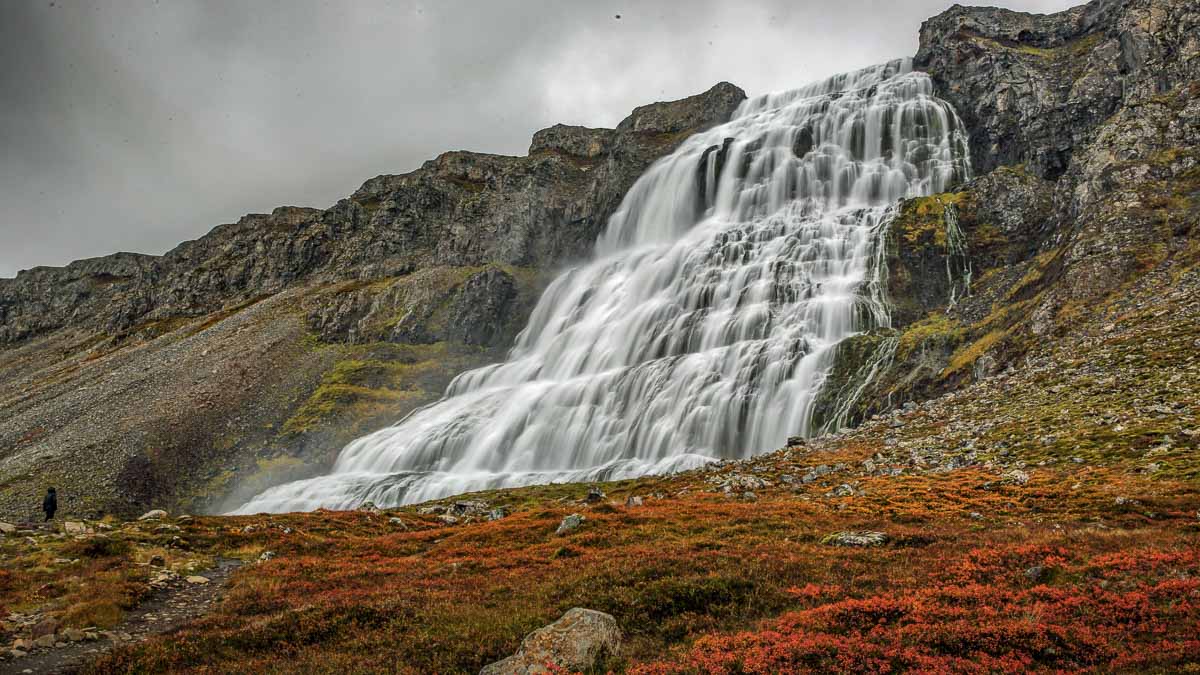
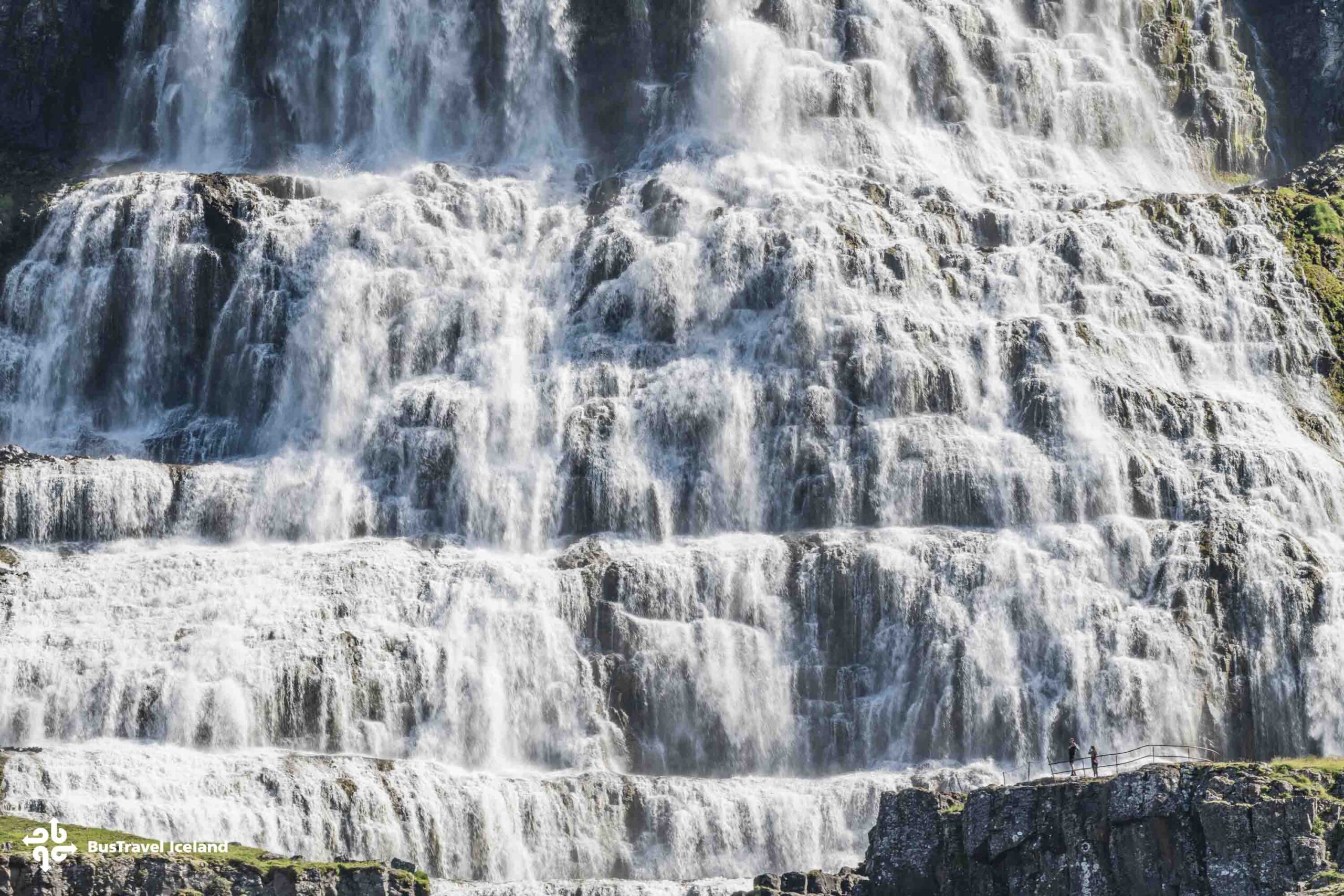
The main waterfall is approximately 100 metres high, but height alone does not explain its appearance. Dynjandi begins at roughly 30 metres wide at the top and spreads to around 60 metres at the bottom. Instead of dropping vertically from a single cliff, the water travels over a great staircase of ancient basalt, widening as it descends. And that is where much of Dynjandi’s charm lies: the water spreads into a thin, delicate veil, with fine mist rising from the rock and softening the edges of the waterfall as it tumbles down the mountainside.
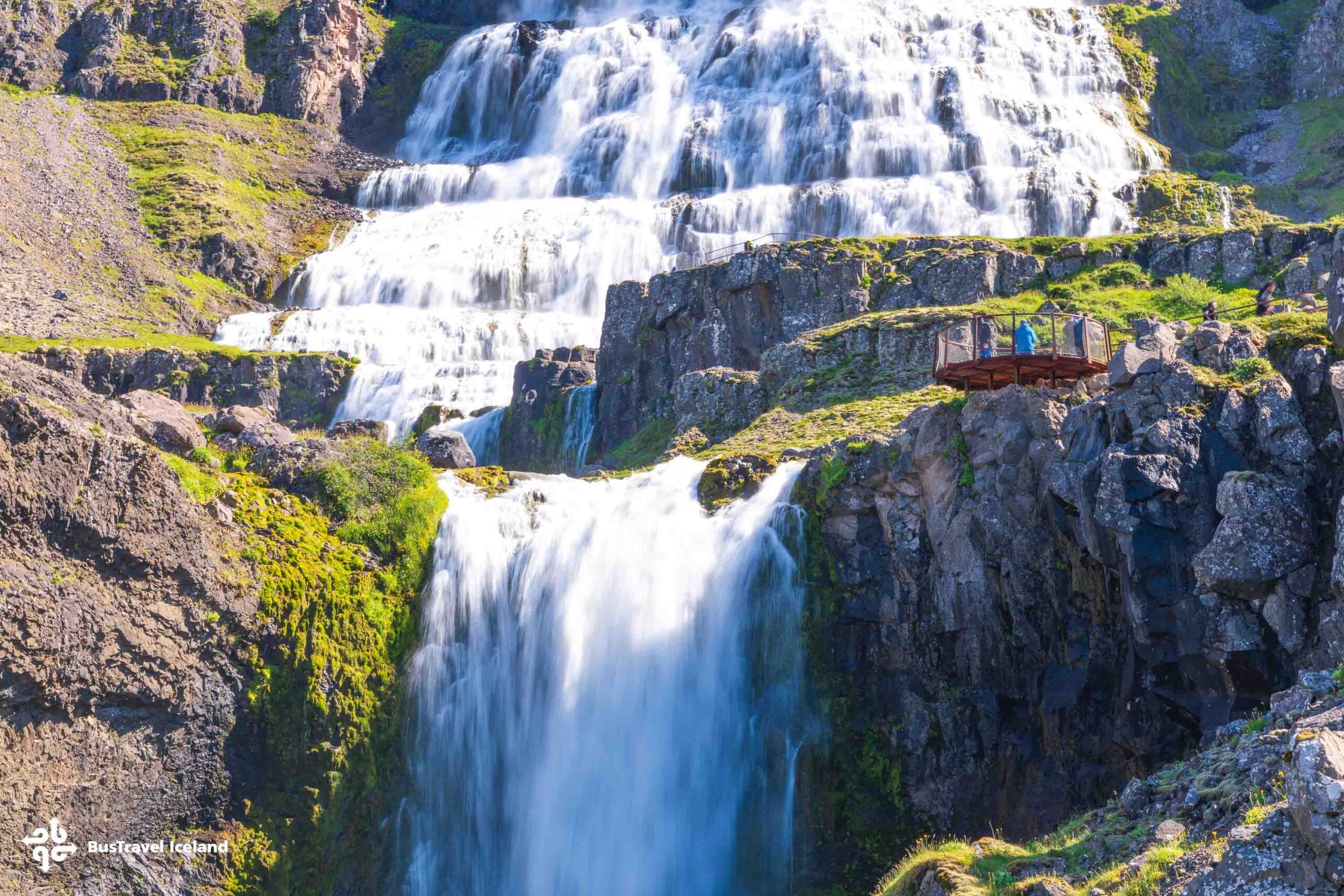
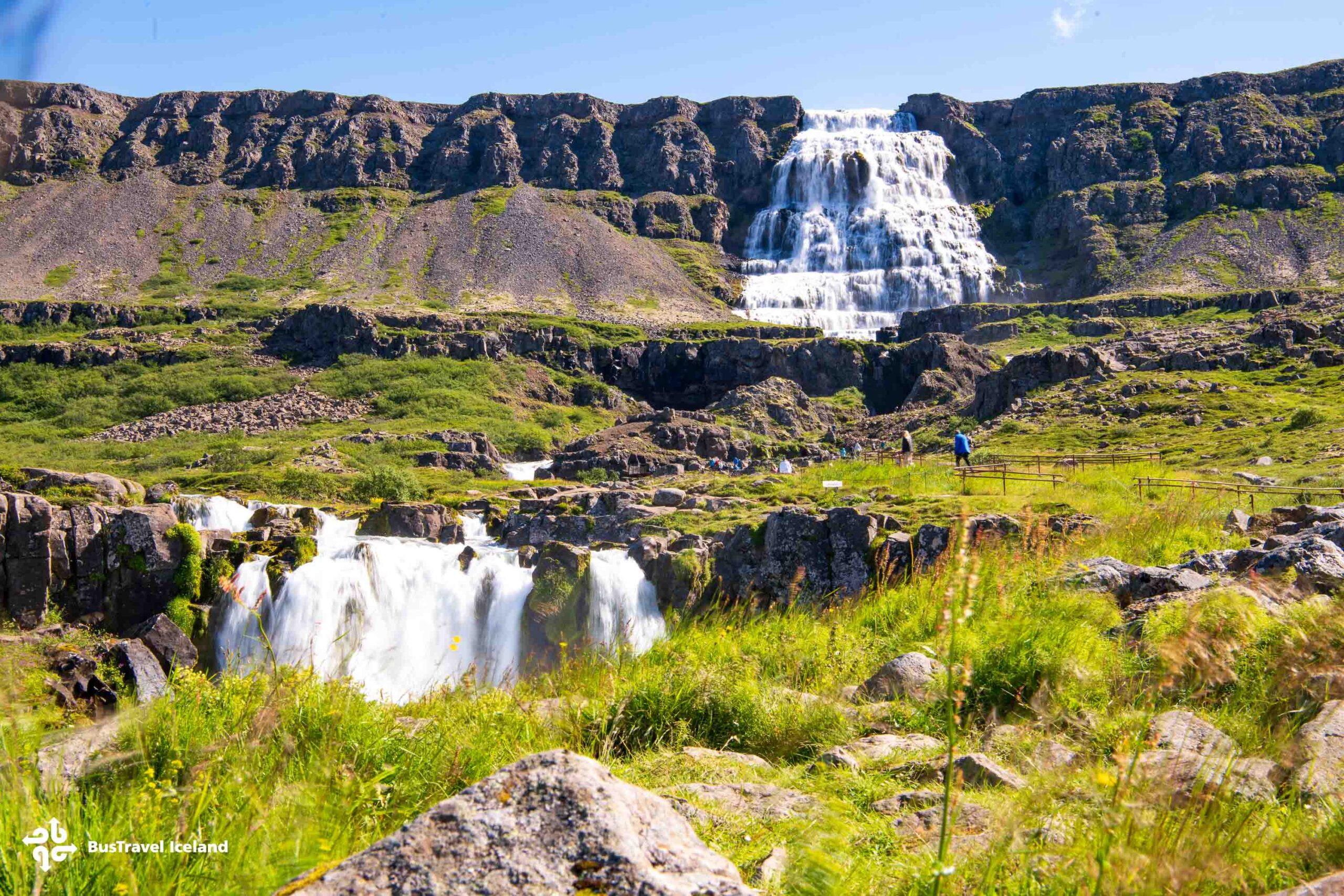
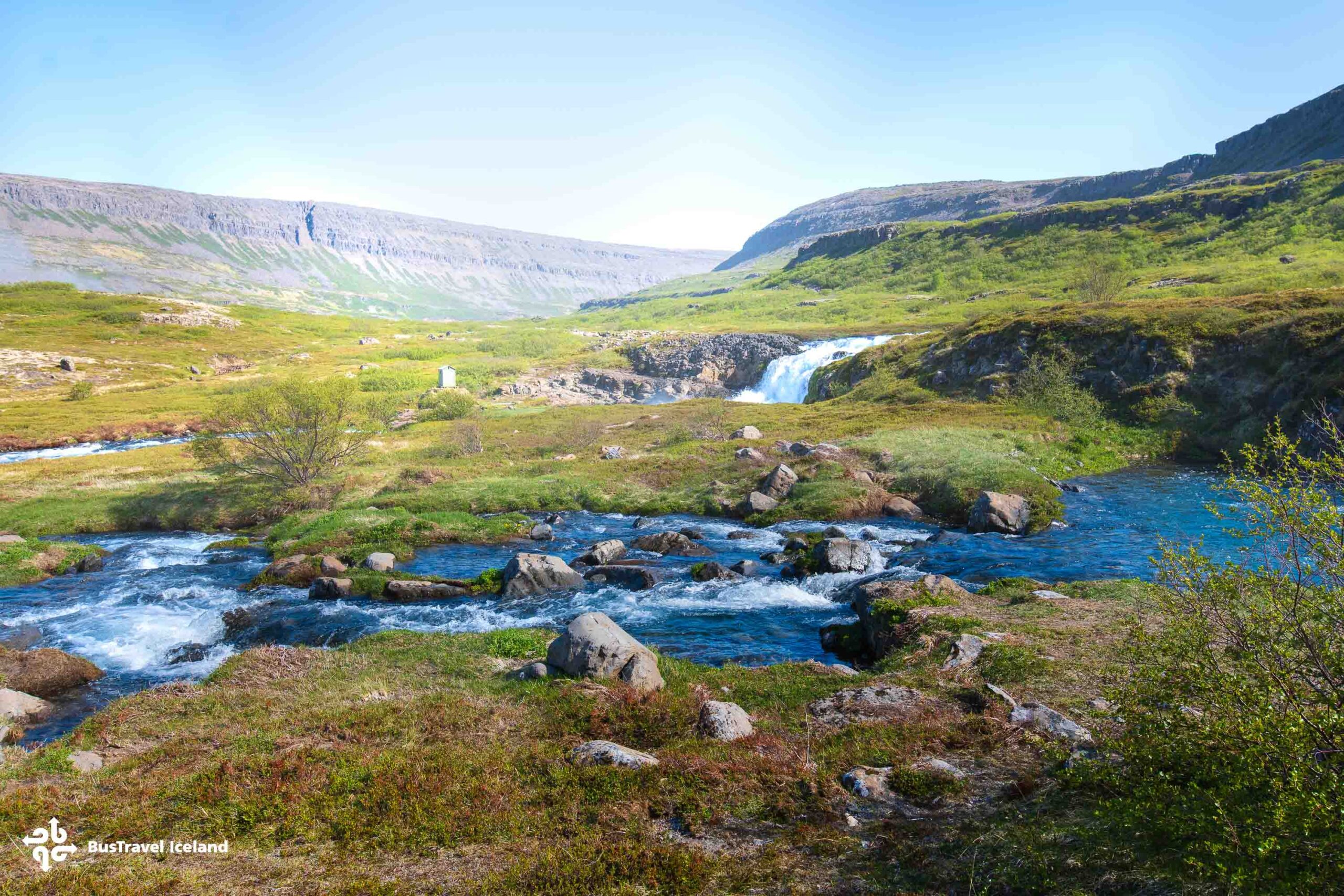
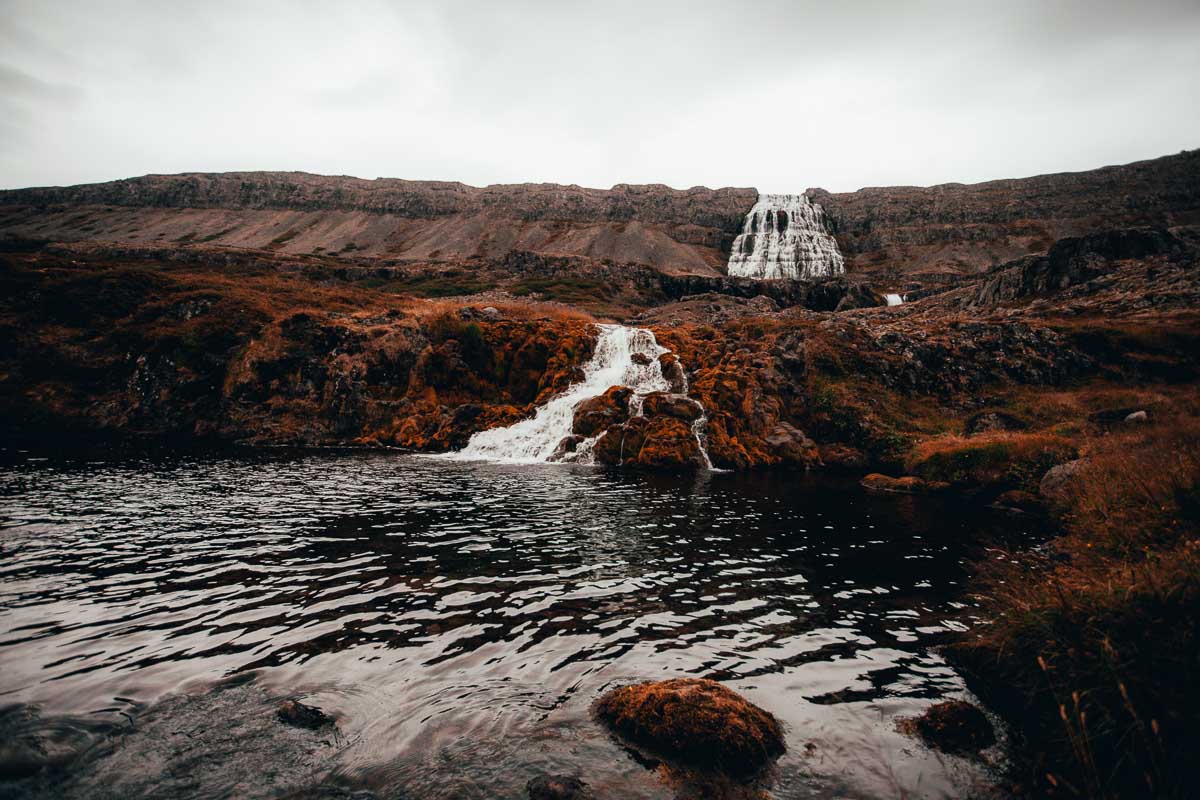
And the waterfall usually called Dynjandi is only part of the story. Below it, Dynjandisá continues towards Arnarfjörður through a series of smaller waterfalls. Visitors approaching on foot encounter these falls one after another, meaning that the walk to Dynjandi is part of the experience rather than simply a route to the main waterfall.

Where Is Dynjandi waterfall?
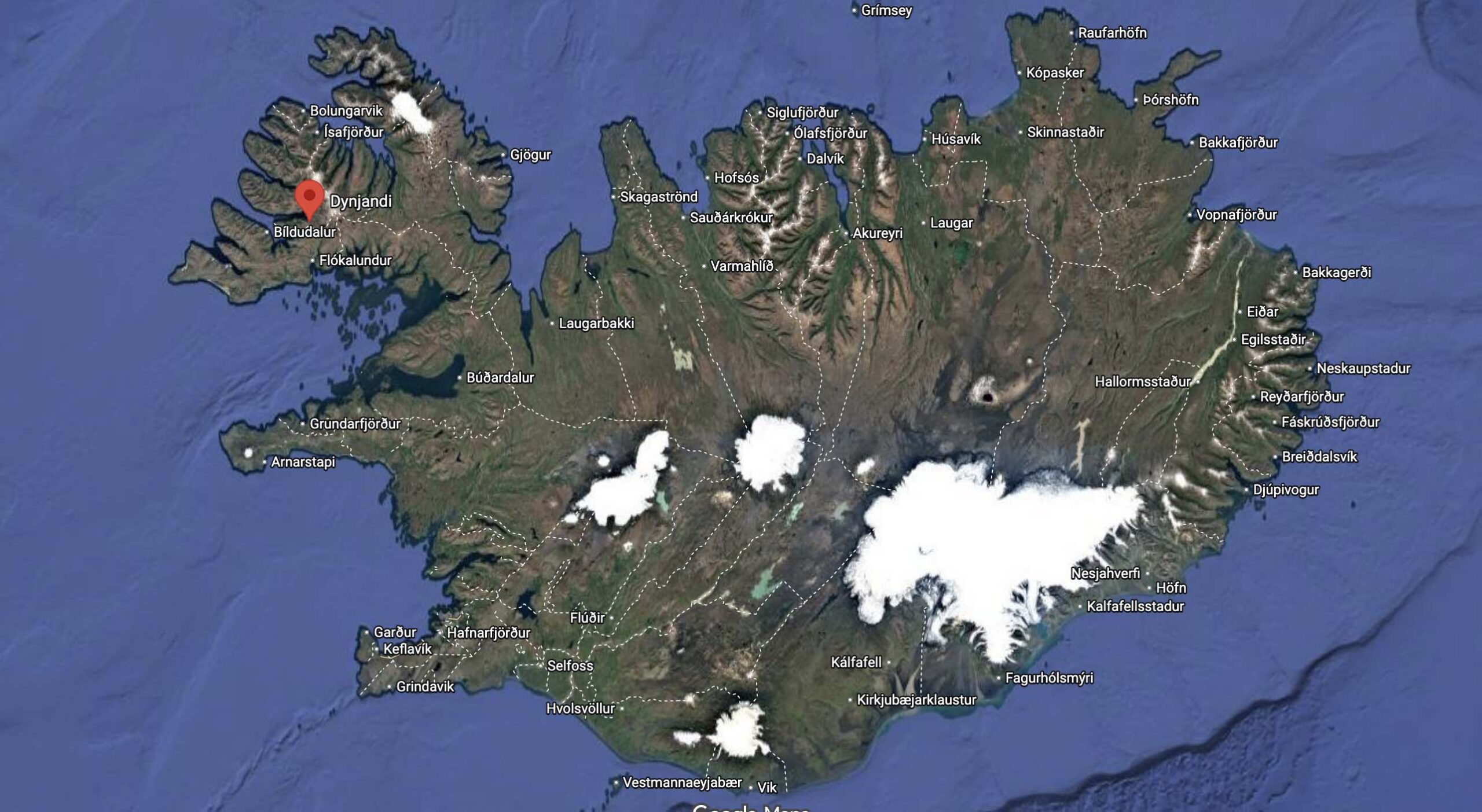
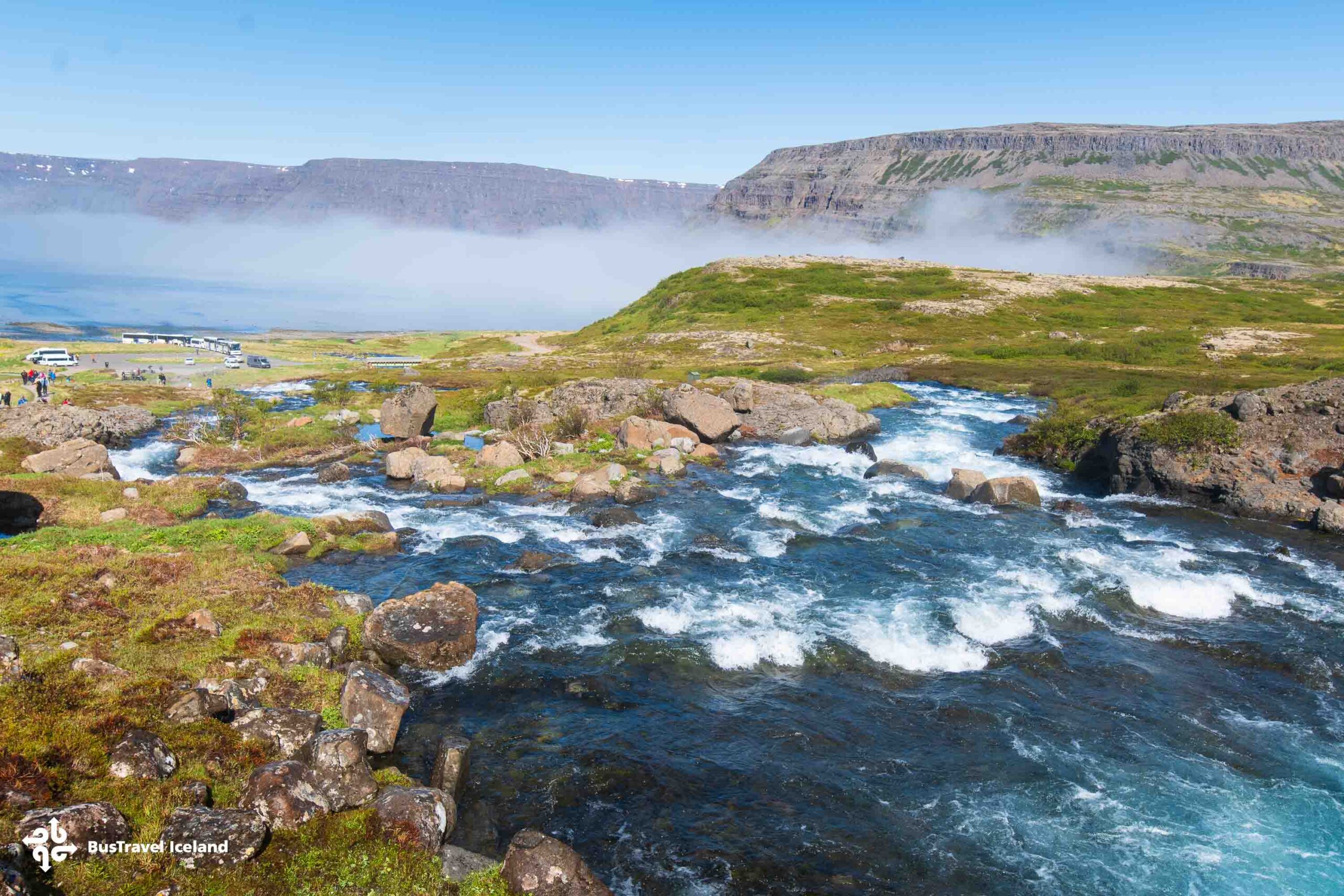
Dynjandi is located at the head of Dynjandisvogur, an inlet of Arnarfjörður in the southern Westfjords.
The waterfall lies beside Route 60, Vestfjarðavegur. From the main road, a short access road leads approximately 700 metres towards the visitor and parking area beside the fjord. The nearest airport is in Ísafjörður, while Brjánslækur, served by the ferry across Breiðafjörður, is the nearest ferry port.
Dynjandi is not surrounded by a town, large visitor centre or heavily developed tourist area. It stands at the end of a broad fjord, with mountains rising on either side and the waters of Arnarfjörður opening behind you as you climb towards the waterfall.
The journey to Dynjandi becomes part of the experience itself. As the road winds along quiet fjords, climbs over remote mountain passes, and passes through some of Iceland’s most sparsely populated landscapes, the outside world seems to fall away. Then, almost without warning, Dynjandi appears across the mountainside—a moment that makes the immense scale and wild beauty of the Westfjords feel wonderfully real.
How Big Is Dynjandi waterfall?
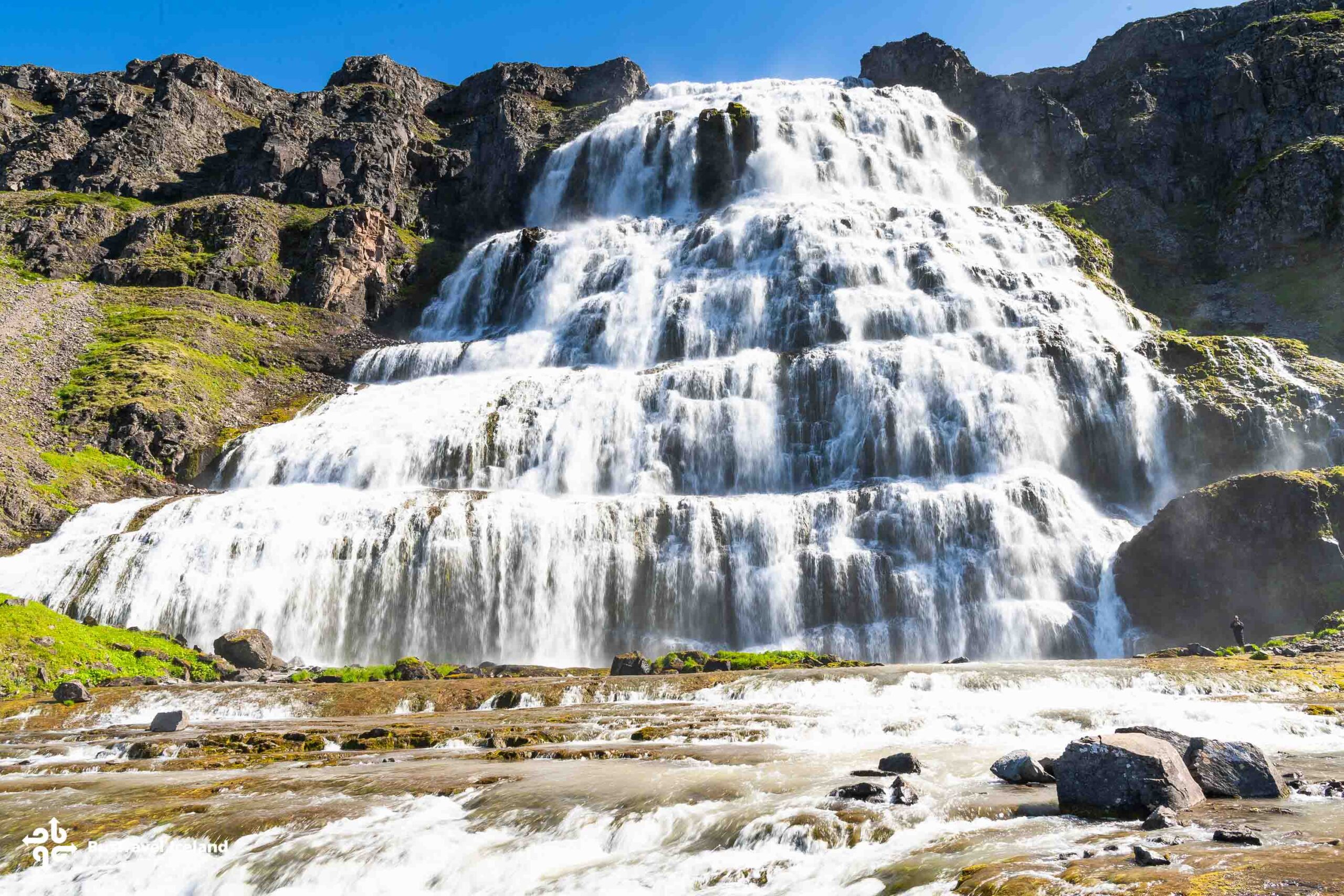
The main cascade is 99 metres high, approximately 30 metres wide at the top and 60 metres wide at the bottom.
That widening shape is one of Dynjandi’s defining characteristics.
Many large Icelandic waterfalls concentrate water into a narrow channel or send it over a sharp cliff. Dynjandi behaves differently. Water spreads across the rock as it descends, creating a broad triangular or fan-like form.
From below, it can resemble a great white veil laid over the mountainside.
But photographs can make the waterfall difficult to judge. With few buildings, trees or other familiar objects nearby to provide scale, Dynjandi can initially appear smaller than it really is. Walking towards it changes that impression. The waterfall grows steadily larger until the individual terraces of rock and the enormous volume of moving water dominate the view.
Why Does Dynjandi Have Its Unusual Shape?
To understand Dynjandi, you have to look at the geology of the Westfjords.
The Westfjords are among Iceland’s oldest landscapes. The peninsula was built through repeated volcanic eruptions roughly 14–16 million years ago. Layer after layer of basaltic lava and volcanic material accumulated, eventually creating a large plateau.
The Ice Age then reshaped it.
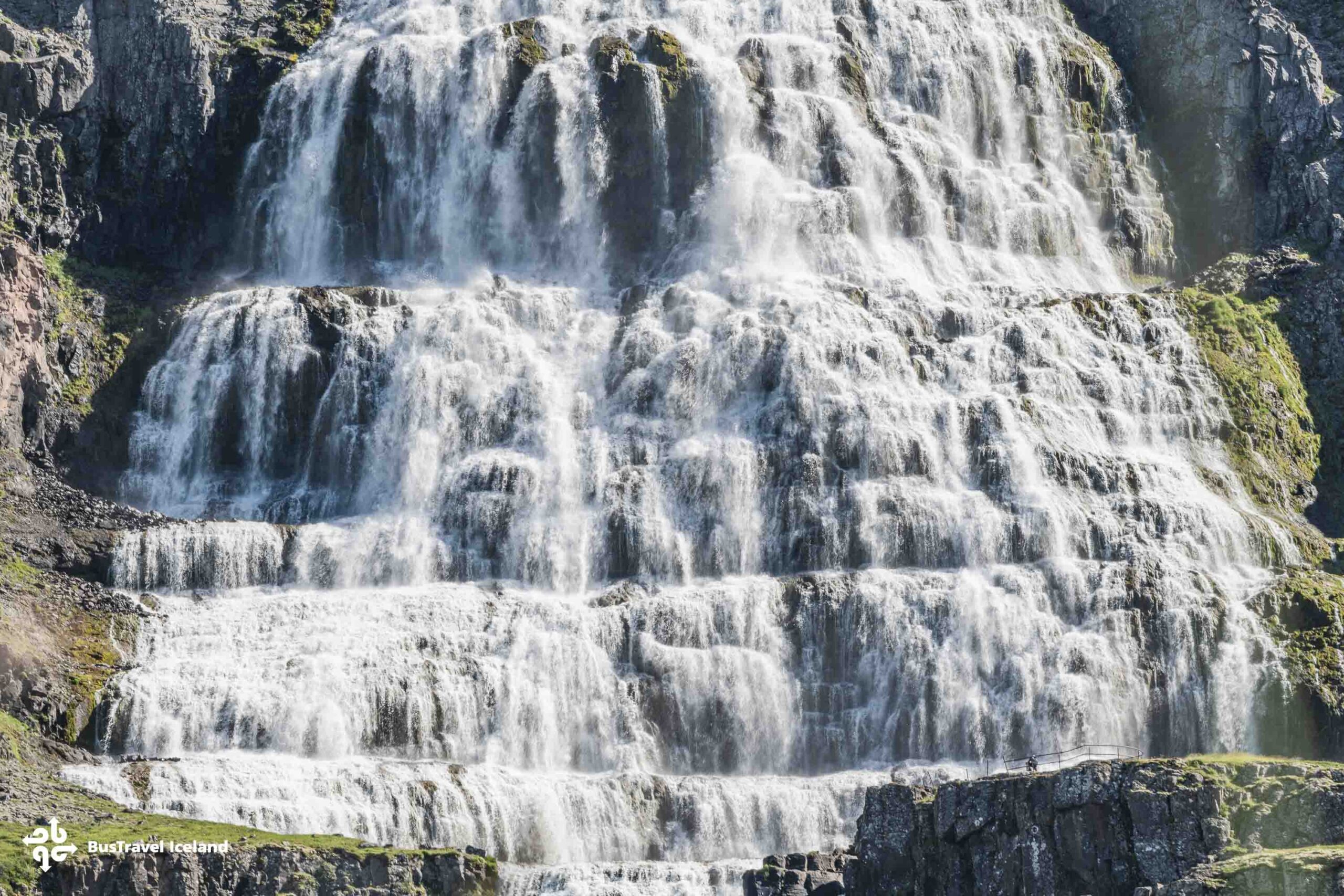
Glaciers carved deeply into the plateau, excavating the valleys and fjords that now give the Westfjords their distinctive geography. Different layers of rock eroded at different rates. Hard basalt resisted erosion better than the softer material between the lava layers.
Those differences can be seen clearly at Dynjandi.
The harder basalt layers form ledges. The softer intermediate layers have gradually been worn away. Dynjandisá therefore descends through a natural staircase in the mountainside rather than simply plunging from one cliff.
The waterfall is, in effect, a visible cross-section through millions of years of volcanic and glacial history.
Where Does the Water in Dynjandi Come From?
Dynjandisá begins in the highlands above the waterfall, around Dynjandisheiði and the edge of the Gláma highland area.
Water collects in a number of lakes and depressions across this upland landscape before flowing towards Arnarfjörður. Official descriptions of the area identify Eyjavatn among the sources feeding Dynjandisá. The highlands around Gláma and Dynjandisheiði were themselves covered by ice until relatively recently in geological terms.
From these upland lakes, the river travels towards the edge of the plateau before beginning its dramatic descent.
After passing over Dynjandi and the waterfalls below it, the river has only a short distance left to travel before reaching Dynjandisvogur and the sea.
Standing near the fjord therefore allows you to see almost the final stage of the river’s journey in one landscape: highland water descending from the mountains through a chain of waterfalls before reaching Arnarfjörður.

Dynjandi Is Not Just One Waterfall
One of the most easily missed facts about Dynjandi is that the famous upper cascade belongs to a much larger sequence of waterfalls.
Names and classifications have varied historically, and modern visitor sources sometimes group the cascades differently. The official nature description identifies Dynjandi itself followed by Hæstahjallafoss, also known as Úðafoss; Strompgljúfrafoss, or Strompur; Göngumannafoss; Hrísvaðsfoss; Kvíslarfoss; Hundafoss; and Bæjarfoss.
This is worth knowing before visiting because you do not simply park beneath Dynjandi and walk directly to it. You follow the river uphill.
Along the way, smaller waterfalls appear at different levels beside the path. Some can be approached quite closely from designated areas, and each gives a different perspective across the valley and fjord.
The upper waterfall remains the highlight, but the journey towards it gradually reveals how the entire mountainside has been shaped by water.
What Does the Name Dynjandi Mean?
The name is unusually appropriate.
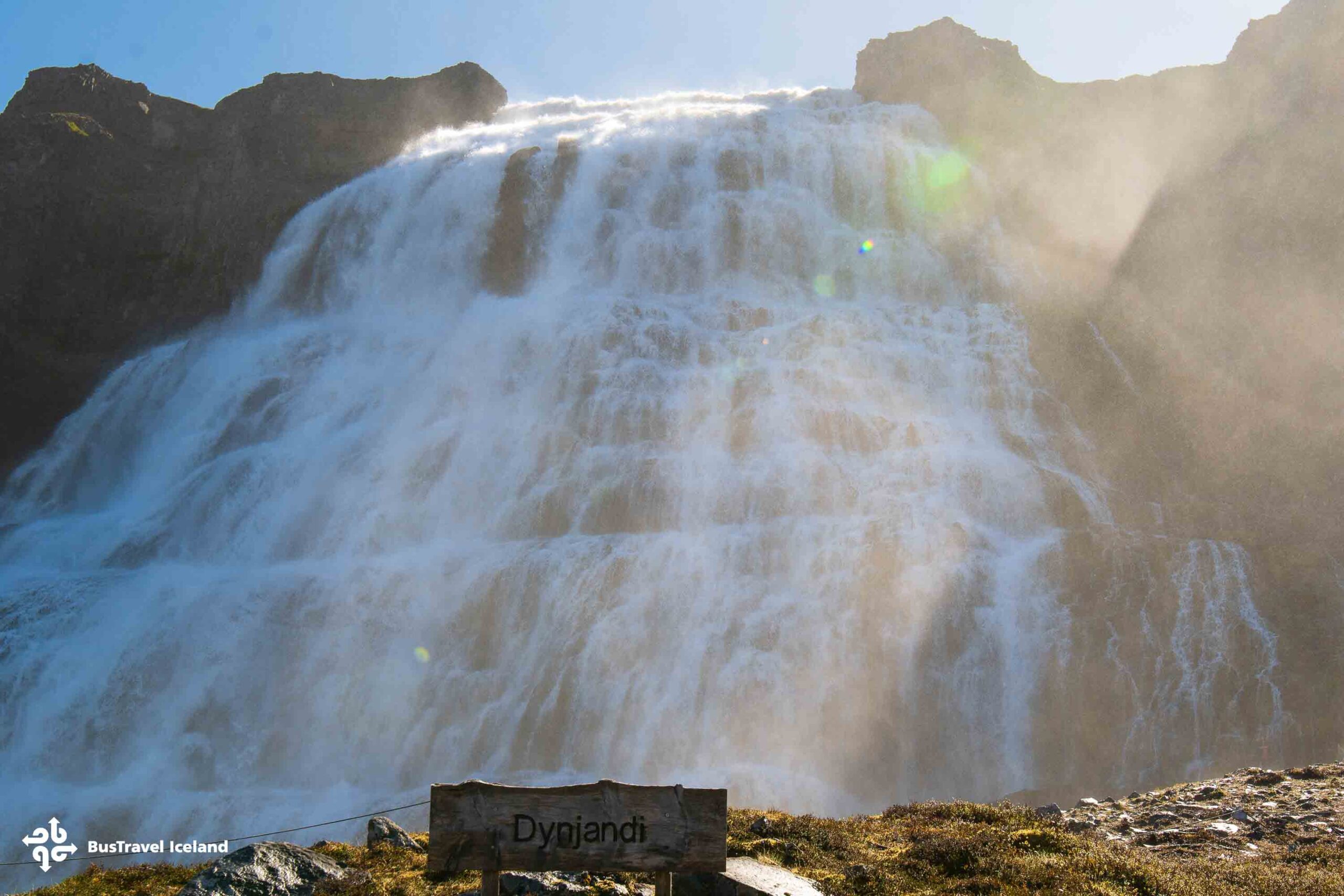
Dynjandi comes from an Icelandic word associated with a powerful, resounding or thundering noise. The name can be understood along the lines of “the thundering one” or “the resounding one.”
You understand the reason better on foot than in photographs.
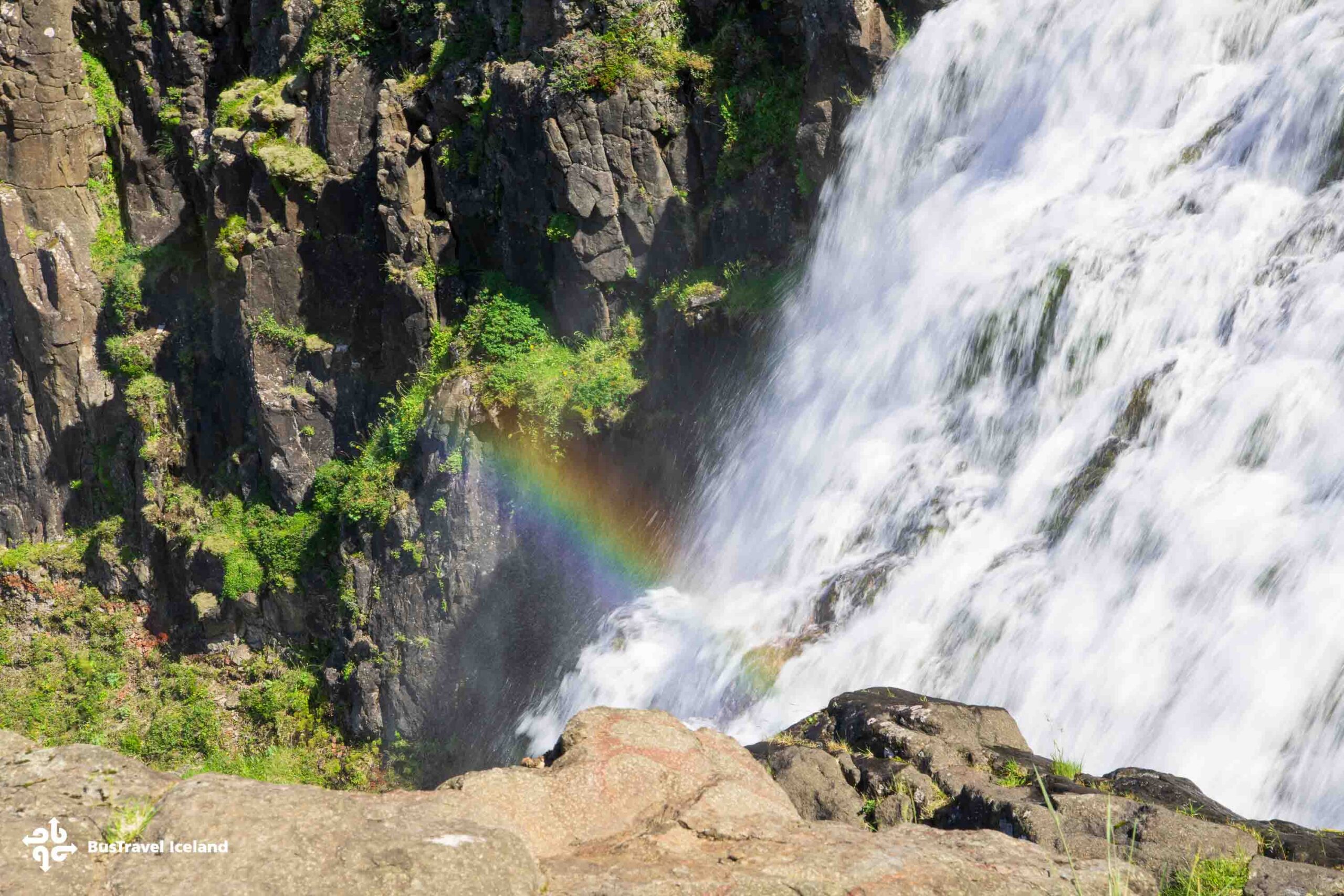
As you climb towards the main waterfall, its sound becomes increasingly dominant. Water strikes the stepped rock repeatedly on its way down, producing a deep continuous roar that carries across the surrounding landscape. Iceland’s environmental authorities specifically note that the sound can travel considerable distances.
Is Dynjandi Also Called Fjallfoss?
You may occasionally see Dynjandi referred to as Fjallfoss. In fact, if you search for Fjallfoss online, almost all the images and information you find will point you straight back to Dynjandi. But there is an interesting historical reason for the confusion.
According to Iceland’s environmental authorities, the use of Fjallfoss appears to stem from an 1839 description of the local parish. That account referred to the farm at Dynjandi taking its name from the large mountain waterfall beside it. The description seems to have been interpreted later as though “Fjallfoss” were the waterfall’s proper name.
The official account considers that interpretation incorrect: the waterfall’s name is Dynjandi. Fjallfoss has nevertheless persisted as an alternative name online, which explains why searching for either name will largely bring you to the same waterfall.
The Walk to Dynjandi waterfall
From the parking area, the walk to the main waterfall takes approximately 15 minutes, although in practice it is worth allowing considerably longer.
This is not a walk that rewards rushing.
The path follows Dynjandisá uphill and passes the smaller waterfalls along the way. As you gain height, the view in the opposite direction becomes increasingly impressive. Turn around and Arnarfjörður stretches out below, framed by steep Westfjords mountains.
The lower section of the path is paved and accessible as far as Hrísvaðsfoss. Beyond this point, the route becomes a natural path that is rocky and uneven in places. Viewing platforms have been constructed at two of the waterfalls.
For most visitors, 45–60 minutes is a sensible minimum for the entire stop. Anyone interested in photography, geology or simply spending time beside the waterfall should allow longer.
Conditions also matter. Rain can make natural surfaces slippery, while wind and rapidly changing weather are normal features of travel in the Westfjords.
Good walking shoes are a better choice than footwear selected simply for a short sightseeing stop.
What Is It Like at the Top of the Trail?
The final approach provides a very different impression from the distant view.
From across the fjord, Dynjandi appears almost delicate. Up close, there is little delicacy about it.
The sound becomes much louder. Spray hangs in the air. The individual steps in the basalt become visible, and water that appears smooth from a distance breaks into countless channels as it moves over the rock.
This is also where the unusual proportions of Dynjandi become apparent. Because the waterfall becomes wider towards its base, it occupies an enormous section of the mountainside immediately in front of you.
The best view is not necessarily the closest one. Part of Dynjandi’s character comes from seeing the full fan of water against the layered mountain, so stopping at different points along the trail often produces a stronger sense of its shape and scale.
A Waterfall Shaped by the Ice Age
Although Dynjandi flows over volcanic rock, much of the landscape visitors see today owes its form to ice.
During the Ice Age, glaciers cut deeply into the old basalt plateau of the Westfjords. Their movement created the steep-sided valleys and fjords that now define this part of Iceland.
The last Ice Age ended around 10,000 years ago, but the highlands above Dynjandi retained ice much longer. According to Icelandic environmental authorities, the Gláma and Dynjandisheiði highlands remained ice-covered until a little more than a century ago.
Dynjandi therefore brings together the two processes responsible for much of Iceland’s landscape: volcanism built the rock, while ice and water carved it.
The waterfall continues that process today, although on a timescale far beyond a human visit.
Dynjandi Has a Human History Too
The landscape around Dynjandi can feel empty today, but it was not always uninhabited.
Historical records of the farm at Dynjandi extend back to the Middle Ages. For centuries the land was used for farming, grazing and the collection of brushwood and fuel. Charcoal production also took place in the area.
The old farm stood on a mound below the waterfall. Traces of outbuildings and other structures remain in the landscape.
Living here required adapting to the same natural forces visitors come to see today. Landslides occasionally affected grazing land, while Dynjandisá could overflow its banks and damage fields. Farmers constructed flood defences along the river, remnants of which can still be identified.
There was even a small constructed geothermal bathing or washing pool on a terrace above the farm. Its water was measured at 26.5°C in the summer of 1887; by 1996, the recorded temperature was 23.5°C.
Permanent farming at Dynjandi finally ended in 1951, when the last residents, Guðmundur Jóhannsson and Guðrún Sigríður Guðjónsdóttir, moved to Bíldudalur. The land continued to be used for some years afterwards.
The remains are a reminder that Dynjandi was not historically a remote sightseeing stop. It was somebody’s home and workplace.
Why Is Dynjandi Protected?
Dynjandi, the other waterfalls along Dynjandisá and their surrounding landscape have been protected since 1981.
The purpose of the protection is not simply to preserve a scenic viewpoint. It specifically protects the waterfall staircase created by the area’s alternating geological layers, as well as the surrounding landscape, vegetation and natural character.
That protection is increasingly important as visitor numbers to the Westfjords grow.
The waterfall is impressive partly because the surrounding landscape remains relatively undeveloped. Protecting that setting means keeping visitors on established paths, avoiding damage to vegetation and respecting restrictions designed to reduce pressure on the area.
Drone use is also regulated. From 1 May to 15 September, flying a drone within the protected area requires a permit. Different rules apply outside that period, but pilots must still follow Icelandic aviation regulations and avoid disturbing wildlife and other visitors.
When Is the Best Time to Visit Dynjandi?
For most travellers, summer provides the easiest conditions.
Long daylight hours make the drive through the Westfjords easier, while roads and walking routes are generally more accessible. Late spring and early summer can also bring substantial water flow as snow melts in the highlands.
But Dynjandi is not a static attraction.
The amount of water, the colour of the mountains, the light across Arnarfjörður and the weather can completely change its appearance. A bright summer evening can make the water appear almost luminous against the dark basalt. Low clouds can hide the upper mountains. Rain and wind can make the landscape feel considerably wilder.
That variability is part of travelling in the Westfjords.
Visitors outside the main summer period should pay particularly close attention to road and weather conditions. Mountain roads in this part of Iceland can be affected by snow, ice and difficult driving conditions long before the landscape at sea level appears wintry.
Photographing Dynjandi waterfall
Dynjandi is one of those places where stepping farther away can produce a better photograph.
A close photograph captures the power and texture of the water, but a wider composition explains the waterfall more effectively. Including the smaller cascades, mountainside or Arnarfjörður gives the viewer a sense of scale and location.
Several perspectives are worth considering:
- From near the fjord, the entire waterfall system can be seen descending towards the sea.
- Along the walking path, the smaller waterfalls create foreground subjects with Dynjandi rising behind them.
- Higher on the trail, turning away from the waterfall opens views across Arnarfjörður.
- Near the main cascade, photographs reveal the stepped basalt and the complex movement of the water.
Because spray can become significant near the upper waterfall, a lens cloth is useful even on a seemingly dry day.
Facilities at Dynjandi waterfall
Despite the remote setting, basic visitor facilities are available.
There are parking spaces for cars, motorhomes and buses, as well as designated accessible parking. A parking or service fee is charged. Flush toilets are available year-round, and the visitor area includes picnic tables and facilities associated with the cooking area.
There is no general waste collection at the site, so visitors should take their rubbish with them.
Overnight stays are not permitted at Dynjandi.
During summer, park rangers work in the protected area, helping manage the site and providing information about its nature and history.
How Long Should You Spend at Dynjandi?
Allow at least 45–60 minutes for a visit to Dynjandi. I have only visited the waterfall once, and I spent about an hour there. At a moderate walking pace, I found that was enough time to make the journey up and down the trail, stop at the smaller waterfalls along the way, and properly appreciate the surrounding landscape.
If you are visiting specifically for photography, however, I would recommend allowing closer to two hours. Dynjandi offers very different perspectives as you move along the trail, and having extra time means you can stop, find your compositions and wait for the light without feeling rushed.
It is worth resisting the temptation to treat Dynjandi as a quick roadside photo stop. The main waterfall is impressive even from below, but much of the experience comes from walking beside Dynjandisá, passing the smaller cascades one by one and watching the relationship between the waterfall, the mountains and Arnarfjörður gradually reveal itself as you climb.
Is Dynjandi Worth Visiting?
I’d say absolutely, without hesitation. But what makes Dynjandi so impressive is not quite what you might expect.
It is not simply the height of the waterfall, the volume of water or the surrounding mountains. What makes the place distinctive is how clearly all of those elements fit together.
The old basalt layers explain the staircase beneath the water. The glaciers explain the deep fjord behind you. Highland lakes feed the river above. Dynjandisá then descends through a succession of waterfalls before reaching the sea only a short distance below.
Human history sits within the same landscape. For centuries, people farmed beneath the waterfall, managed its floods, grazed animals on the surrounding land and lived with the constant sound of water descending from the mountain.
Today, we experience that landscape differently, following the river uphill as Dynjandi gradually reveals itself with every step.